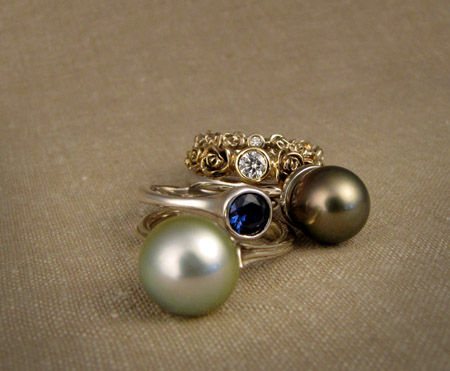
I recently took a bunch of glamor shots of my rings. Here are some of the better ones..
Most of these rings you have probably seen before. I’ve been working on how to get better photos of things that are highly reflective and I think I did really well with this batch. Now I just have to figure out how to get the danged camera to focus where I want it to!
Ronin and I spent an evening not eating any dinner (her) and dancing to various youtube video songs. Here are some winners..
Okay. This is one of my favorite all-time finales of a movie hands down point blank period and that’s final. Maybe it was the movie, but maybe it was simply the wicked edo-period tap dance. A great number of movies could be made better with a full-cast tap number finale I believe. (It starts out pretty cool but seriously gets extra fucking awesome around 1:20.)
And if you are a major Japanese movie geek and happen to have a fetish for Kitano Takeshi, here’s a little treat: Beat Takeshi vs. Shamisen. If you like this, you should seriously follow this thread (I live in a small world evidently: I’ve NEVER seen anyone rock on a shamisen until now).
Here’s another dance number mash-up I’ve watched about a million times by now:
Two words: CYD [and] CHARISSE. My god. Can it get any better? This video makes me tear up at the end actually. It’s kind of embarrassing (and it’s not because of MJ).
Do you like Bollywood numbers? Here are a couple to watch.
My daughter (she is two) is into dance and has a special affinity for ballet (would you believe..). Sometimes on hard mornings, we watch a bit of Giselle to take the edge off The Shrill. This has to be my favorite of the Act 1 variations (of the billions out there):
I don’t know why I like the hop-hop-hop-twirl-twirl-twirl bit so much (1:00) but wee little Gelsey does it the best out of all the little ballerinas on the internets. It makes me sad that the only recorded version is in so crap of shape. Bugger.
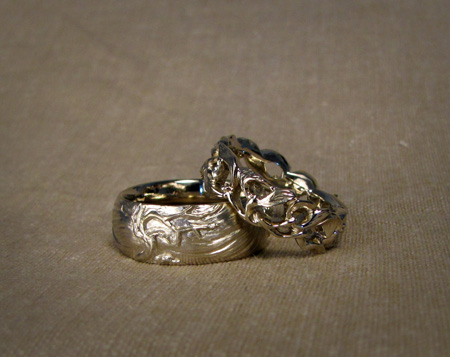
Hand-carved mistletoe wedding band with wide ocean wave and tree band. 18K white gold. Kirsten loved the mistletoe motif but my 11mm band was a little too much.. So I carved one 6mm—and I designed a mistletoe solitaire to match. She had a kick-ass old-style cut family diamond to set in the top.
I wish I got better photos of these rings. I reworked my photo-taking setup and the improvement is obvious. I had been diffusing the light at the light source rather than at the piece; it makes a massive difference. Photos from now on will be much much better. But anyway..
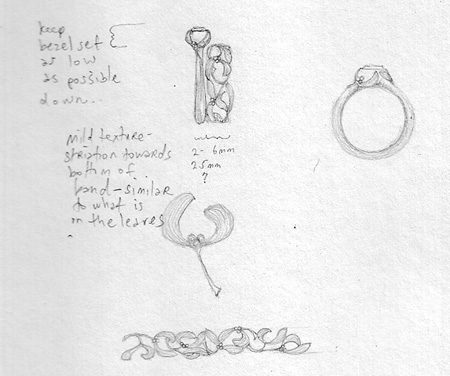
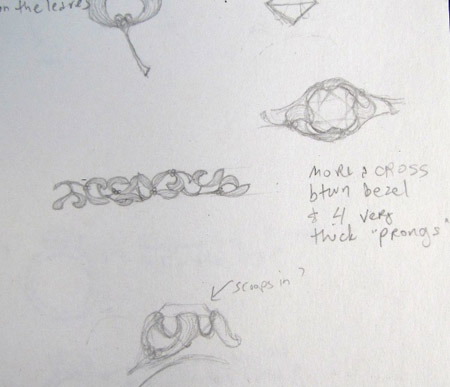
First sketches had a solid bezel with sprigs of mistletoe climbing up each side. However, we were concerned that the solid bezel might limit the bling factor from her old-style cut (modern brilliant cut diamonds return all light that goes in; older cuts sometimes did not..). So, I re-worked the design and opened up the bezel, letting light into the sides of the stone. The mistletoe leaves would hold the stone in place.
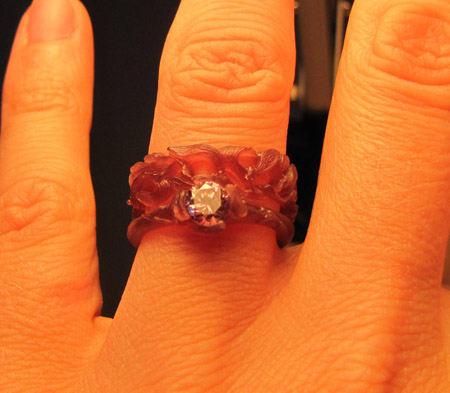
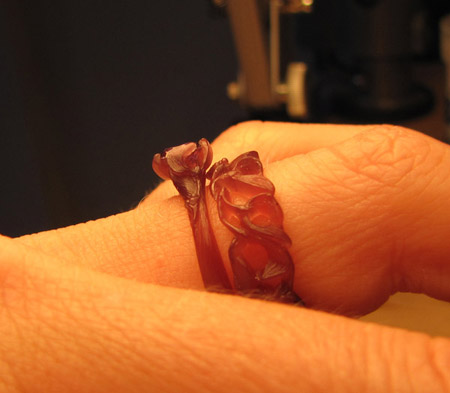
The wax shows that the solitaire does not actually sit flush with the band, as is usually the fashion, but is instead tapered gently up near the top. Not everything that is in fashion is the best and this is a way better design, trust me.
The stone is a lavender CZ I stuck in place to pretend. It’s only a tiny bit smaller than her diamond would be.
See? Graceful! (Not stumpy.)
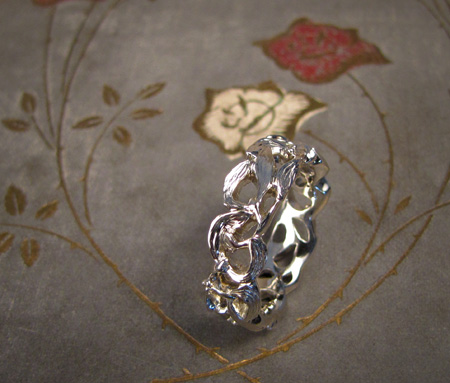
The finished mistletoe band. It measures 6mm in width. It’s an odd thing to think about but as I carve more and more, I get better (it’s hard to call it “practice” since I’m doing it for real, so to speak). Not only am I more efficient and exact in my carving, but my designs are more sophisticated. My 11mm mistletoe ring is one of the rings I wear the most & I love it to death but I have to say, the design on this one is better.
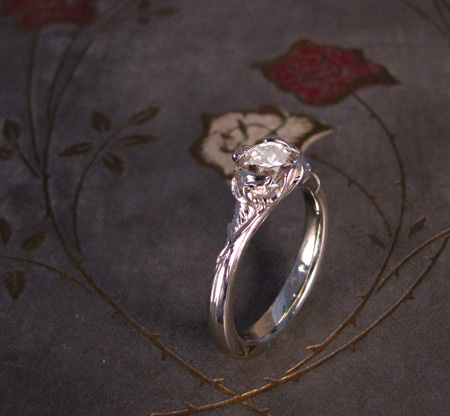
The finished solitaire. Kirsten was too paranoid to send her stone all the way from the UK in case of possible loss by the post office so she had the stone set in the finished ring once she received it. I photoshopped a photo of an old-European cut diamond in where the stone should go just to get a nice photo of the final piece.
OCEAN RING:
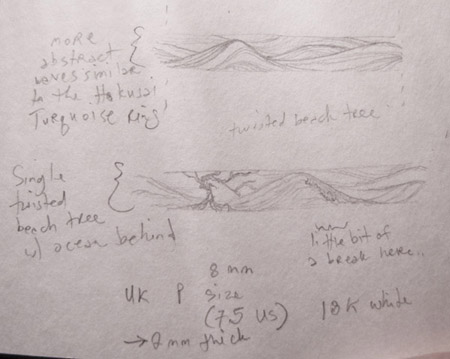
Mark wasn’t exactly sure what he wanted but knew that he preferred a nice wide band. He is into surfing and outdoorsy stuff and liked the water motif on Jeff’s ring. I sketched the following:
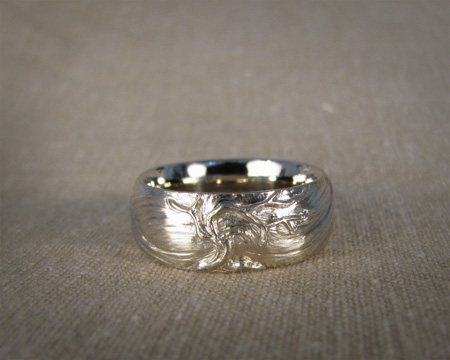
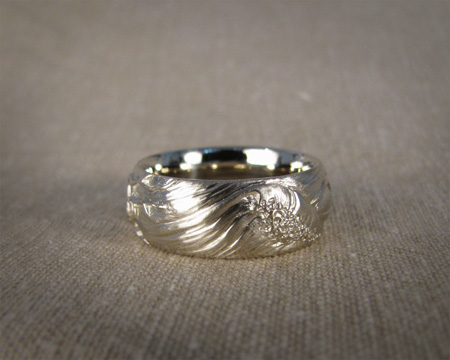
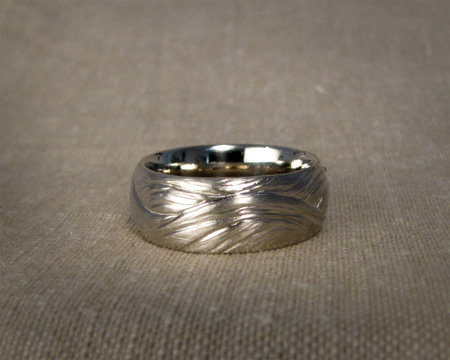
All was a go and here’s the pics of the final ring. Each third of the ring has a different motif: gnarly old beach tree with water, water with breaking wave, just water. You can turn the ring around depending upon your mood.
The ring has a matte finish with a mirror polish on the rounded inside. I think it turned out beautifully.
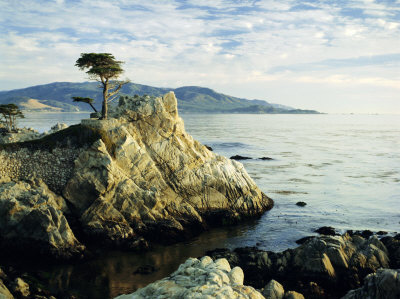
After I finished the ring, it occurred to me that I had carved essentially the Lone Tree of Carmel. Nuts!
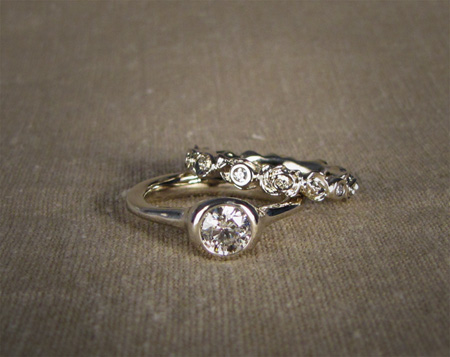
18K white gold solitaire with .60 ct diamond engagement ring with rosy diamond eternity band.
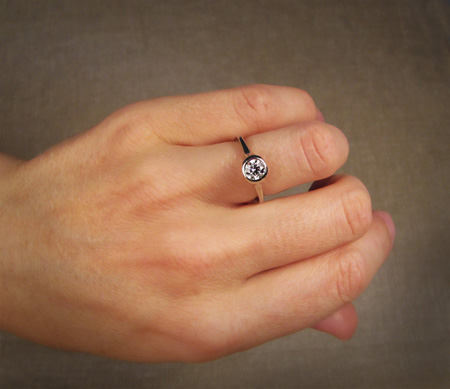
I’ve finally carved a solitaire ring to match my carved bands. It’s very sleek and simple with a tapered band at the top and thicker, wider band at the bottom. This helps keep the ring balanced on the finger (keeps the stone UP and not flopping around) and I think gives a really simple design a lot of grace. It doesn’t fit flush against the carved bands like you usually see engagement ‘sets’ but I think that’s what makes it look unique and cool.
[The diamond is REALLY awesome. It’s G color and SI1 clarity with ideal cut and polish/symmetry; the SI1 inclusion is singular and unobtrusive and 99.99% of the stone is perfectly clean. A really great diamond I think.]
I will probably carve a straight banded solitaire as well but I love the look of the tapered band the best.
Here’s the pair of rings I often wear together:
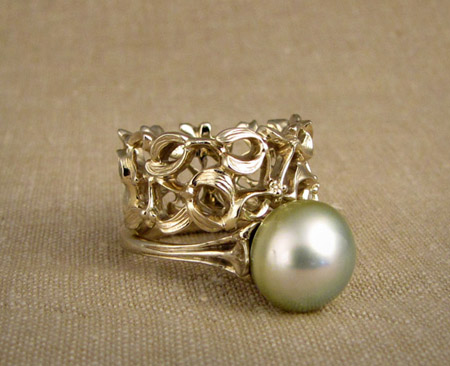
I began wearing it just because an 11mm wide band wasn’t really giving the impact I was looking for… And then I realized how cool the tapered band looked paired against the carved ring.
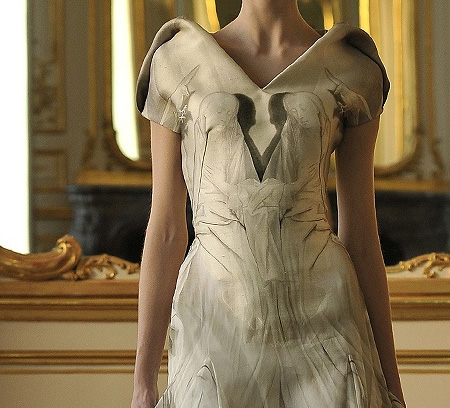
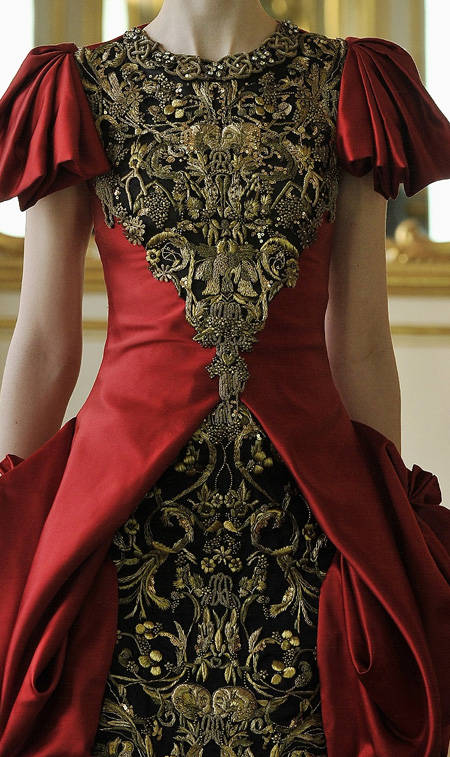
I’ve followed fashion peripherally; mostly I just want to seem some pretty pictures and if I’m lucky, there’s some neat jewelry too (but usually not). Lee Alexander McQueen killed himself this past February and here are some images from his last collection (which was shown after his death).
They are downright breathtaking. Like jewels.
The random but nicely symmetrical scattering of design is something I can fall to pieces over. This is what I love most about people like Renee Lalique (and there is a lot to love about the dude, my link is but one paltry example; do a google image search and be blown away).
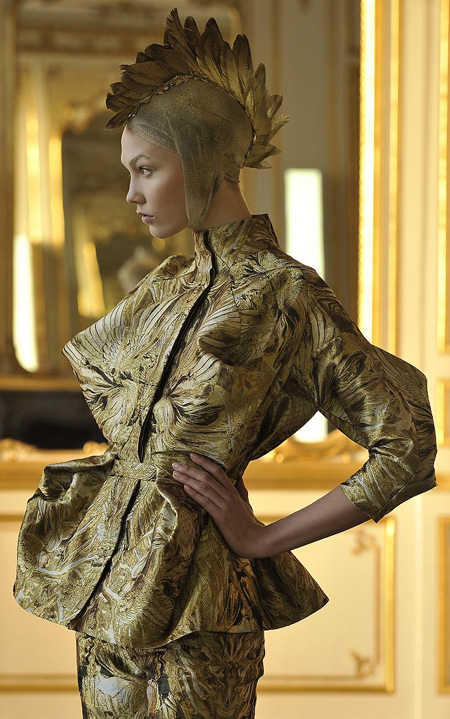
All models had these austere head-dresses covering their hair and ears. This one has a feather mohawk (I have a complete picture of the mohawk down below) but most were just the head covering.
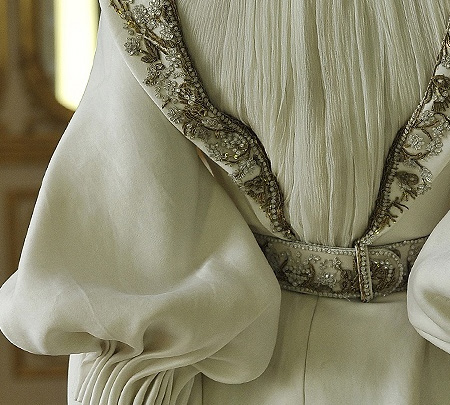
Pretty textures. I like the scrunchy rough texture of the gauzy translucent bunched fabric (I’m sure it has a name) and then the smooth silky weight of the outer layer (look at the veiny texture). I have an affinity for crazy contrasted with constricting. (No alliteration intended.)
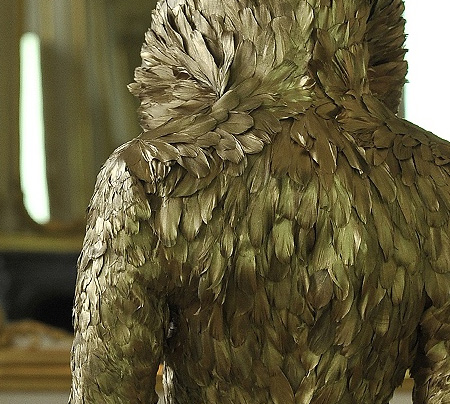
O. M. G. I Love This. Are they real feathers painted gold? I would love to think they were actually gold feathers. Or even real feathers sprayed with real gold paint… From a jewelry standpoint, they have a look like gold (14K or maybe 18K) patinaed with age. You so rarely see gold patinaed but I love the look and have been experimenting with it myself.
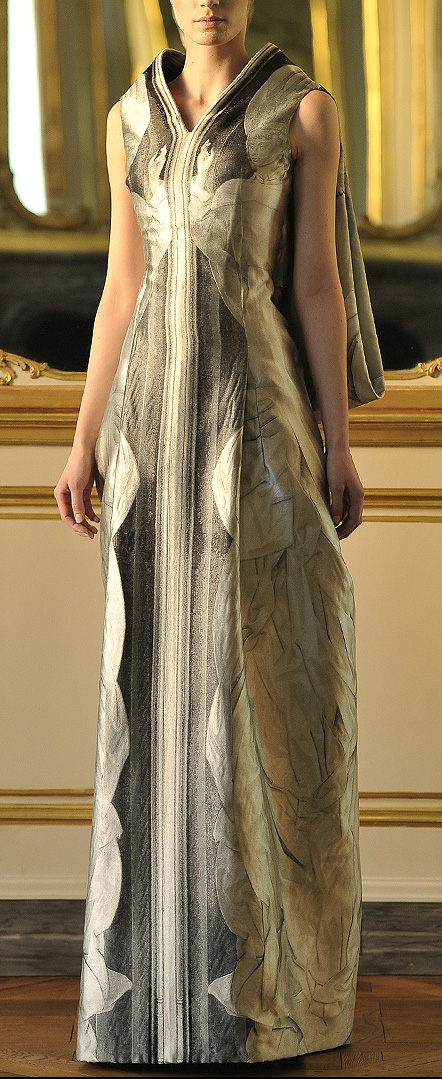
I’m freaking out over the print of skrinkled drapey fabric over perfectly smooth silhouette. Funny that it makes even real folds and shadows incorporated into the art. (You see the wings?) This is where I start to flail over which one is really my favorite…
…because oooh oooh oooh oooh ooh! How cool is this?!?
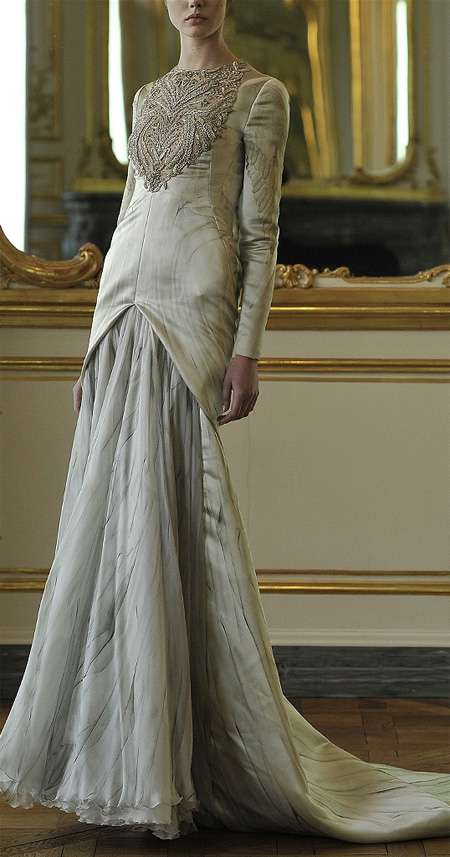
Holy cats! Or this?!? The dress goes on to be light and foamy and fluffery through the full-length skirt.
Heavy pomegranite silk. With intricate gold embroidery. I love this. Seriously, this would take me a zillion years to make (…if I knew how to sew and embroider and all that).
Here’s that headdress I was talking about. A golden feather mohawk!
And right at the point where I get super excited about this artist—I do the same thing when I discover a great new-to-me author, and go to search out what other books have been written and enthuse over what is to come… And then I remember that the man who created this is now dead; there is no more coming. It’s a sad, depressing thing, and makes you wonder what goes on in the minds of brilliant people. I don’t often get choked up over people I didn’t know personally who have died (there are very, very many, after all). But it happens.
All images and many more (plus greater detail) from here.
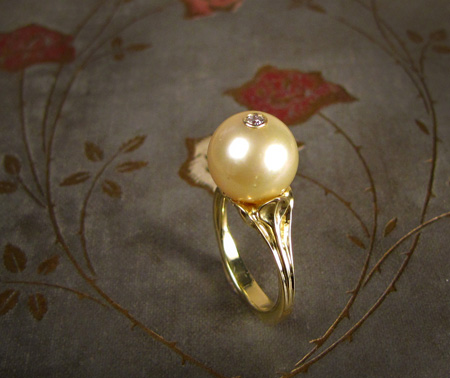
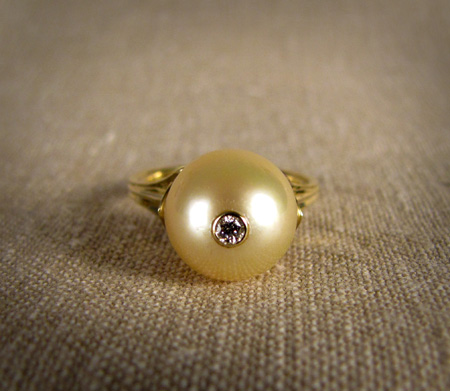
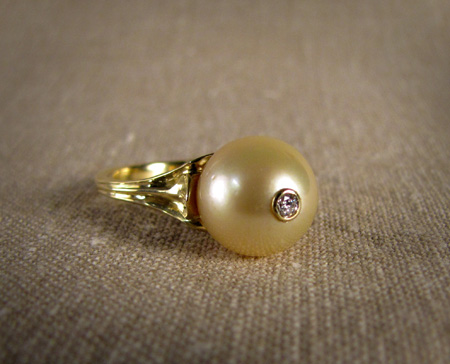
You have no idea how much I stressed over drilling out this big beautiful golden pearl.
Jacquelyn contacted me with this pearl conundrum: she had a pearl that came from a necklace (so it was drilled all the way through) but wanted it for a ring. So… could I maybe set a stone or do something not weird with the hole in the top? Being me, I’m all “We should put a diamond in that hole.” So I got to work. I made the wax, adjusted it to size, got it cast, finished it out, set the diamond in the tubing, shaped and prepped the tubing to be set in the pearl, prepped the mounting for the pearl… and then I stopped and sweat for like a week.
I was terribly paranoid about chipping the surface of the pearl when I drilled it out for the diamond stud. I drill pearls all the time and I use special pearl drilling bits, but they are only small holes, like 1/2 millimeter in diameter. This was to be a 2.5mm diameter hole and as far as I know, they don’t make special pearl drill bits this size. Regular twist drills don’t work; they trash the nacre and chip it all to hell. I have tried. One could suggest that I had two chances to set the pearl: once on one side and if that didn’t work, then I could set the failed end down and have a fresh chance. Naturally, that idea sucked because I just couldn’t give back a pearl all wanged up even if the wanged-up part was set down into the ring and invisible. Also, the pearl had a couple of little dits on one end; this end needed to be set down in the ring mounting. So basically I had one chance. GAH!
I decided to treat the pearl like it was a normal setting job and used the tools I use to set diamonds. Bud burr, setting burrs, etc. The trick seemed to be that I had to drill the pearl at an extreme angle to keep it from chipping (I know this because I trashed two other practice pearls figuring it all out). Then once the nacre is opened up, you can drill straight down. It took a steady hand and a lot of patience but when I finally got my nerves together to do the real thing, it worked flawlessly.
I was never so happy to put that ring in the box and tie a little ribbon around it and send it off. Would I do it again? ABSOLUTELY! My god just look at how awesome it is:
Like a jeweled gooseberry. With a big sparkley bead of dew on it. YUM.
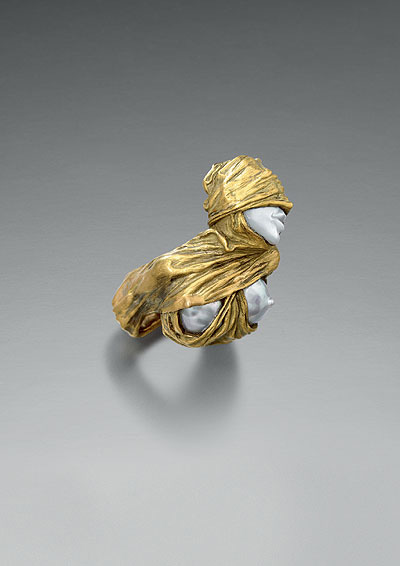
I have some new stuff coming soon.. In the meantime, here’s a photo of a ring that I found last night while browsing the internets and which I think is about the raddest thing ever:
God I love it. The quality of the fabric rendered in gold is awesome and I love the light patina the gold has——makes the wrap look like soft and unbleached like raw linen. The artist is Kevin Coates, and the piece is titled Yseult (Isolde of Tristan and Isolde fame). Here’s what he had to say about it,
A few years ago, I received one of those intriguing little boxes in the post which usually celebrate the remote cutting of a wedding-cake. Upon opening it, the box, bereft of nuptial crumbs, cradled instead a lonely baroque pearl, shyly featuring not one, but two, ‘nipples’. The charming accompanying note from a fellow jeweller, well-known for her wonderful work with pearls, said that she thought that I may be able to think of something to do with it. It remained fallow, but not forgotten, for some time, until the idea for this ring about Yseult (for Wagnerians: Isolde) occurred.
I bisected the orphan gem in order to liberate the two wanton nipples, and although the refractory qualities of mother-of-pearl differ from the superficial aspects of pearls themselves, I managed to find a good colour and nacre-density match from which to carve the segment of face.
The power of drapery to conceal and reveal, to reserve and to promote, is immense – here I also wanted it to stifle and restrict, to reflect Yseult’s fatal love for Tristan. That was a passion destined never to be celebrated with its wedding cake… SOURCE
I really want to start expanding my carving to include other substances rather than casting wax. Unfortunately, I fear change and much of my hesitance is due to stress over not knowing what tools to use, what to try to carve first… All dumb stuff I can probably solve in three minutes with google.
In the meantime, I’ll just continue idolizing other awesomecarvers out there and dream of trying my hand someday. Soon, I think.
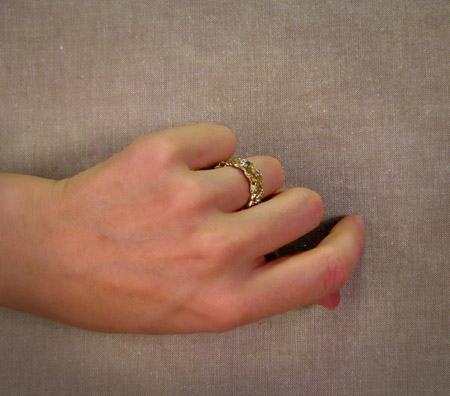
[This is what my hand looks like this morning; I feel very decadent when I do this.]
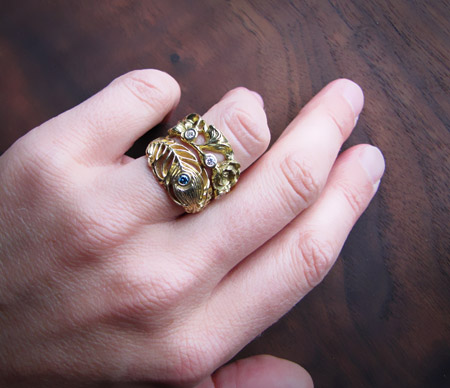
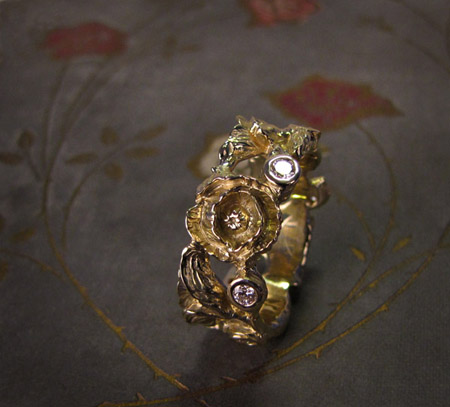
I have a couple of new pieces to show off today: the Poppy Eternity Ring and the Peacock Ring! I’m quite excited about the two pieces and have been wearing them (one, the other, and now this morning: both!) nonstop this past weekend.
First, we have the Poppy. I carved this actually a long time ago as a wedding set for some friends. I only now decided to re-work it to offer in the shop. I decided it might be cool with a few diamonds and so I re-did the poppy buds to hold little 2.5mm diamonds.
I’m really happy with how it turned out. It’s now listed in my Etsy shop.
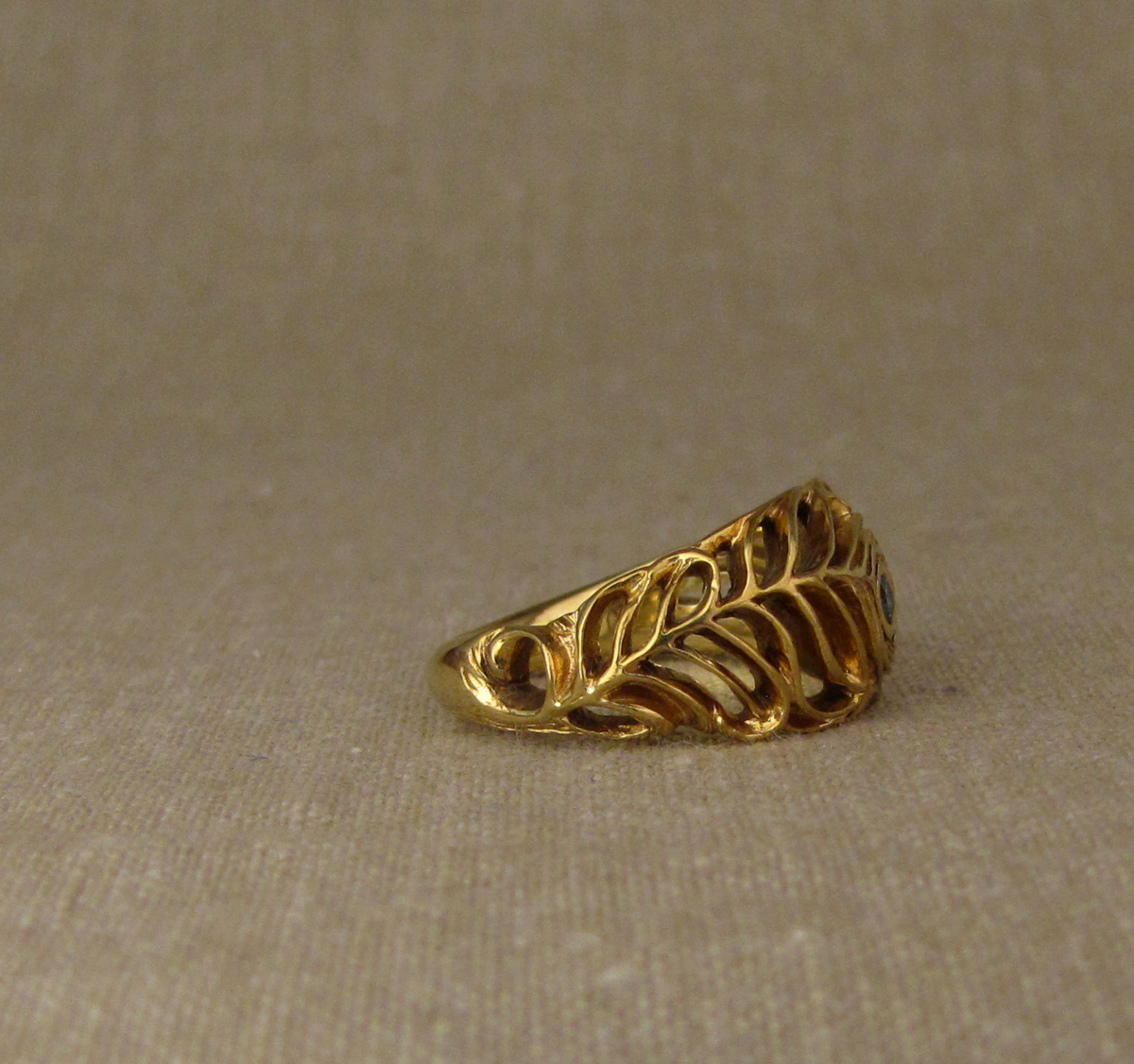
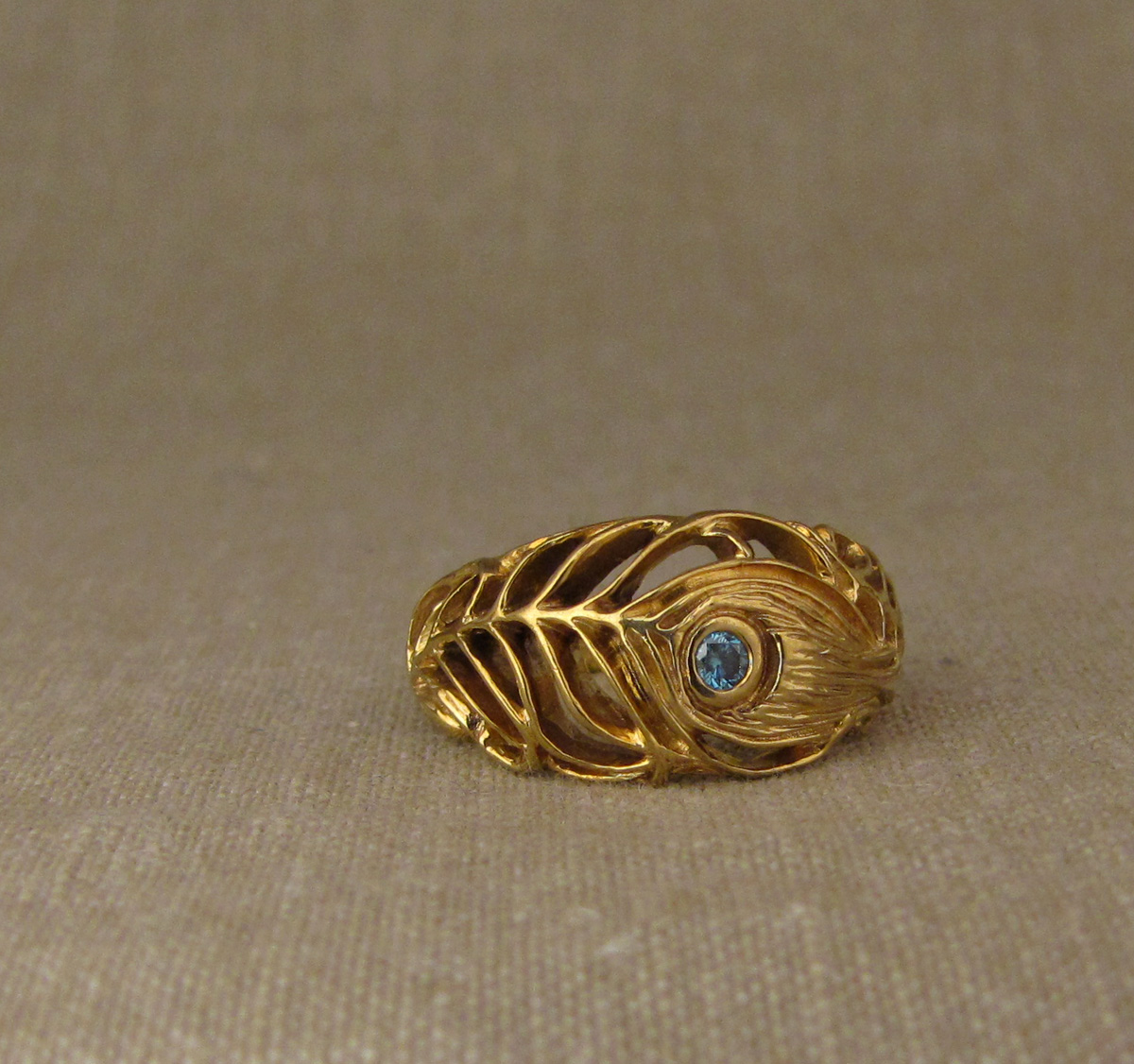
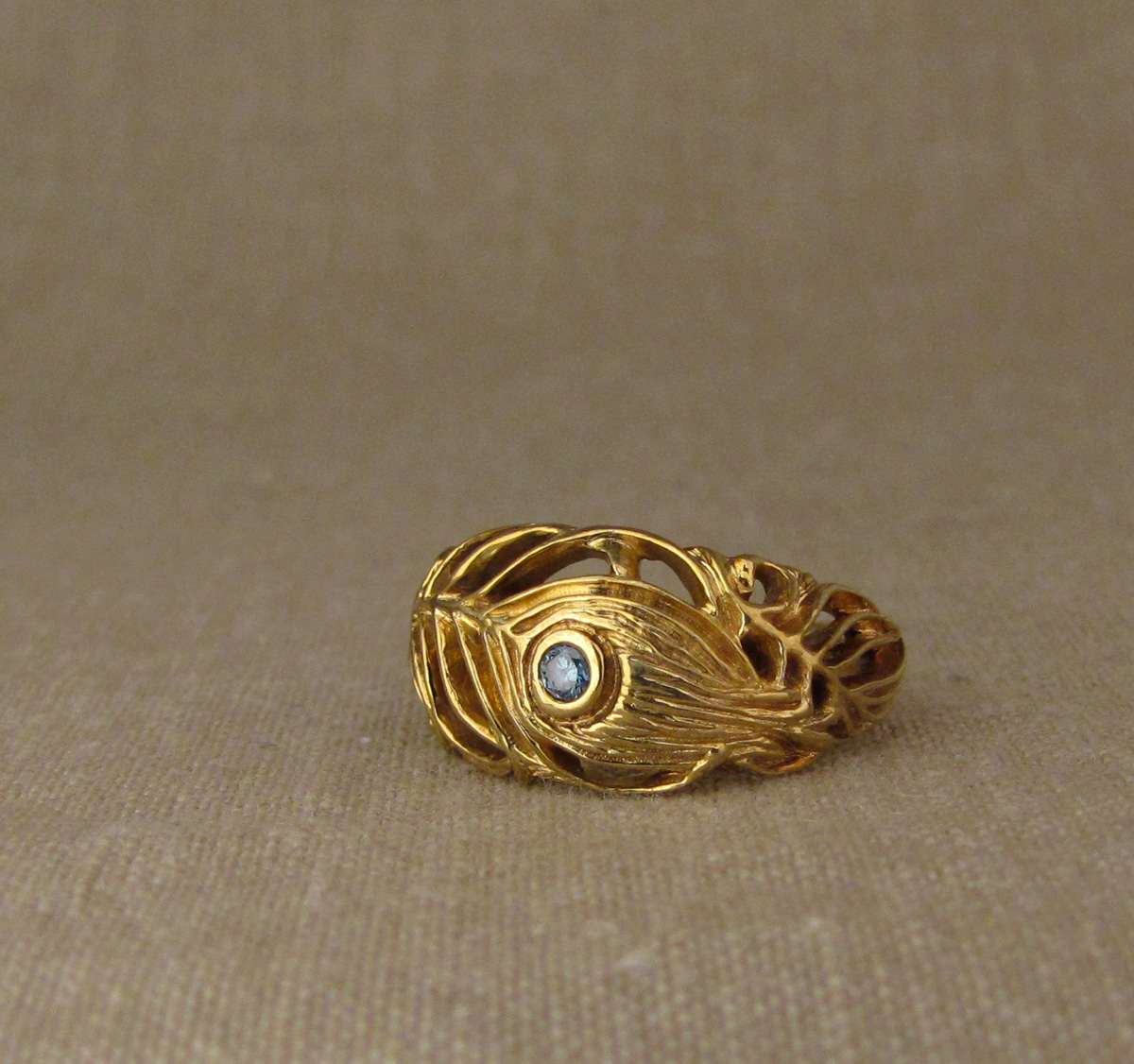
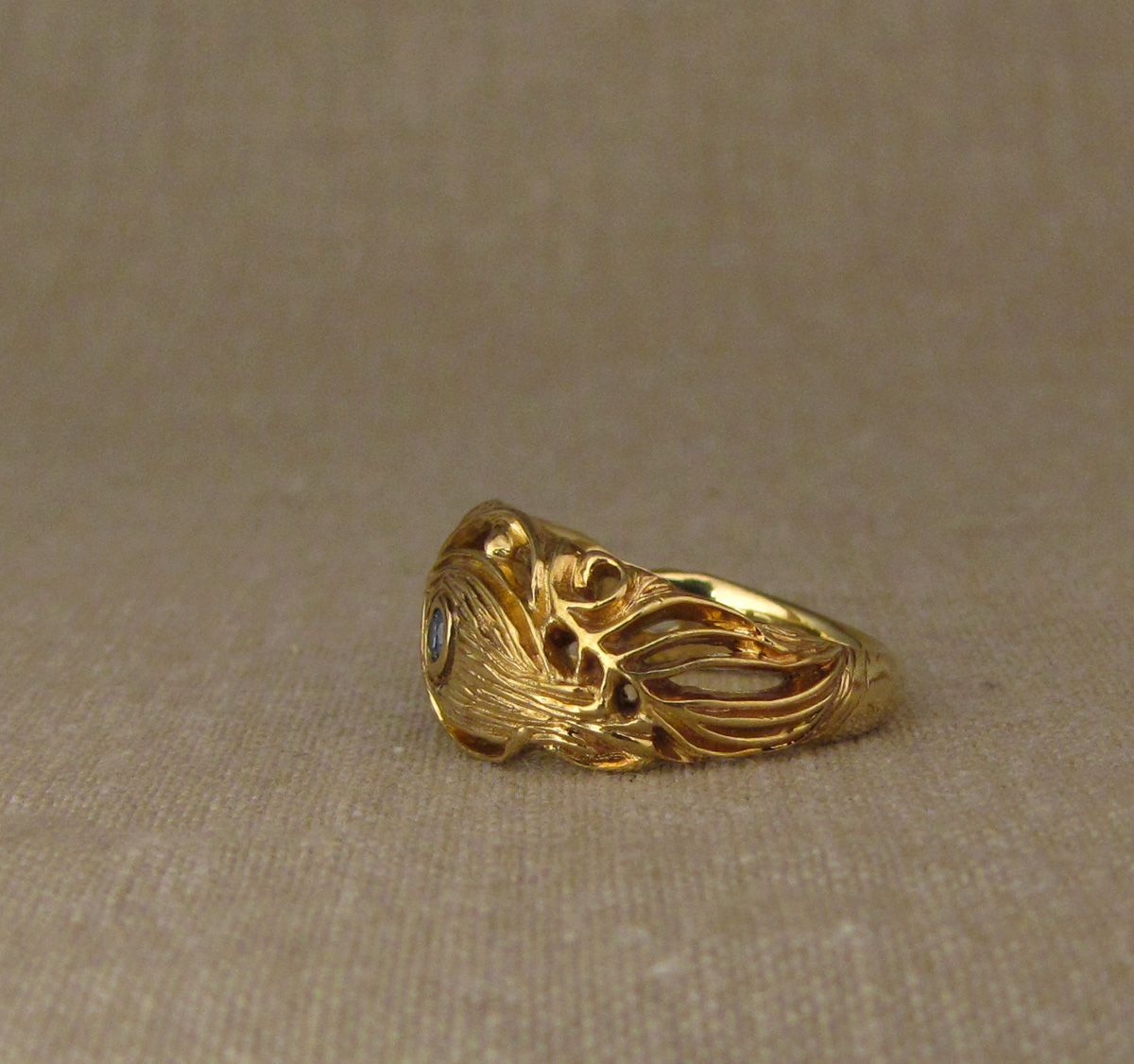
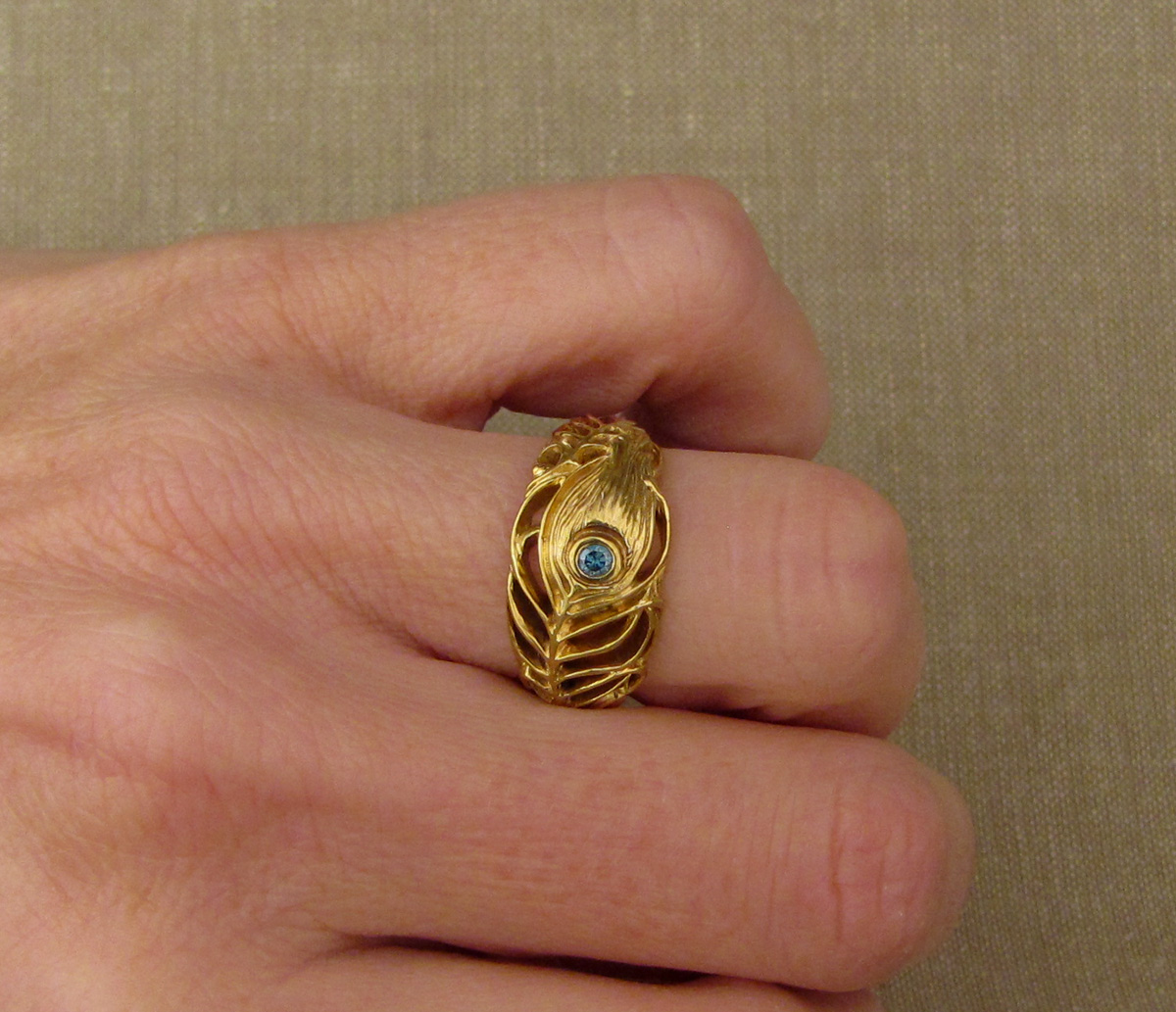
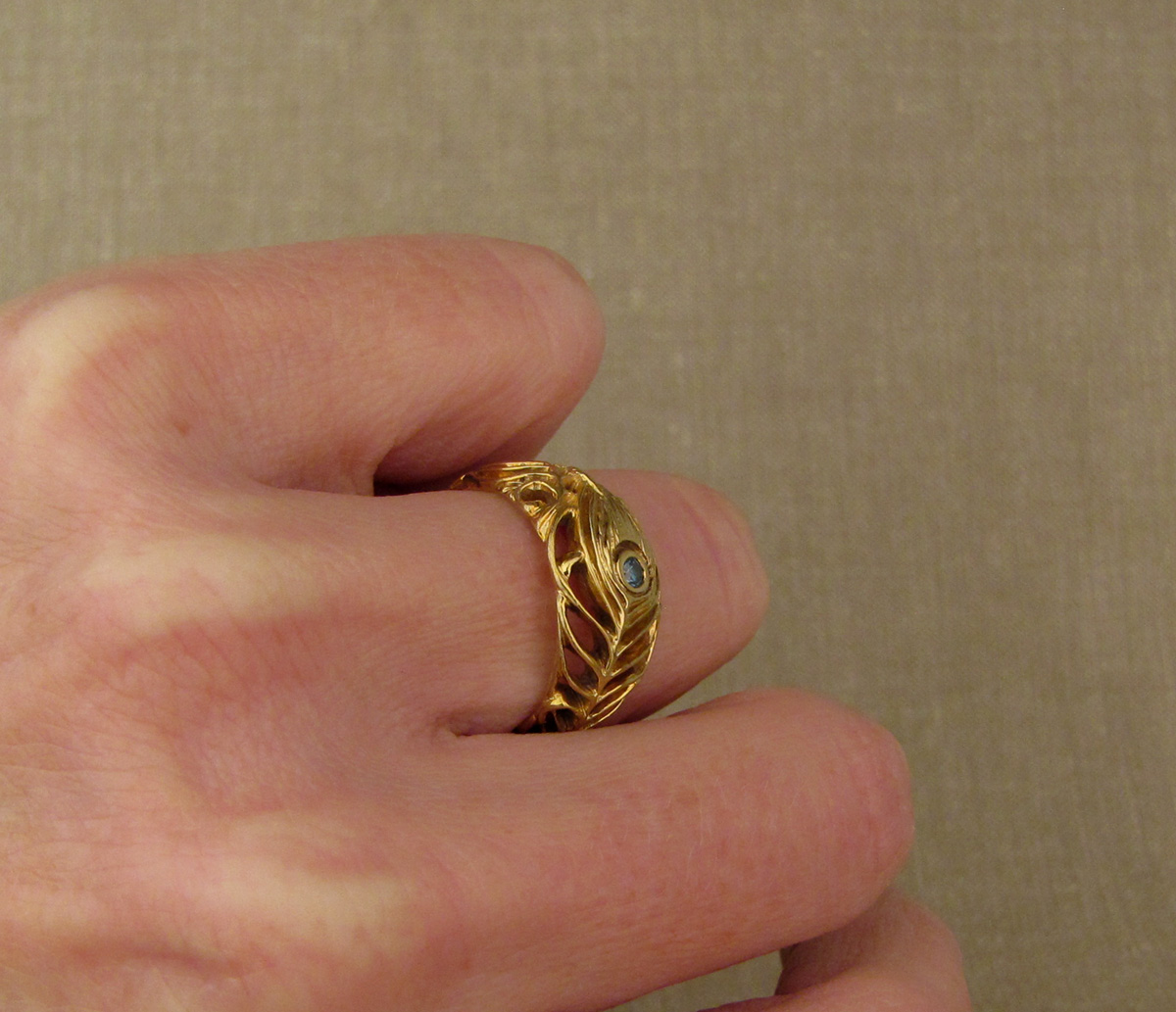
The other ring I just finished is the Peacock Ring. I LOVE it.
This probably looks familiar.. I carved a similar more petite version for Caty’s wedding ring. Carving her ring inspired me to dig out my old peacock ring wax (started years ago but never got very far) and give it another go. The design was a little different though in that I had the peacock’s body on one side, the feather (pretty much like it is now) on the other. It is a lot wider than Caty’s ring but narrow at the base for comfort; I also left the bottom of the ring bare and uncarved. I picked and scratched at it a little and finally decided to cut out the bird altogether, which was just looking a little too scrappy and messing with my clean lines. I recarved it wider on top and made it domed slightly (it’s hollowed out lightly underneath). I’m pretty pleased with the result.
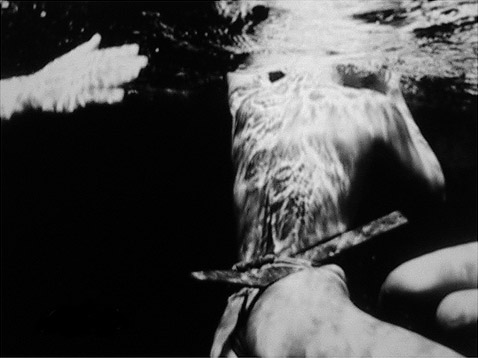
[Underwater Photograph by Fosco Maraini from his book, Hekura, The Diving Girl’s Island.]
I’ve had pearls on the brain lately and it got me to thinking about the ocean, diving, books and movies with diving scenes… specifically, the traditional Japanese women divers, called ‘ama.’
The scene I recall most vividly from a movie is the one from Tampopo. The gangster is at the seaside in his stylin’ cream suit where he sees a young ama, cold and dripping, climbing up onto the rocks with her basket of oysters. She offers him one, he cuts his lip…
I love the last bit where you see the other amas watching from the waves. (Incidentally, if you have never seen this film, you really should—and not just for the oyster porn.)
In another movie scene that comes to mind, the ama are treacherous. The hero dives into the water and encounters a group of them. They surround him and pull away his mask (ama dive without air). There is a strange gang-mentality/siren/dumb-playful group of seals sort of thing going on; they are not specifically trying to kill him but rather just messing with him. Unfortunately, I can’t remember what movie this was. A Bond movie? I know that Kissy Suzuki was supposed to be an ama but I didn’t think I had seen that one.
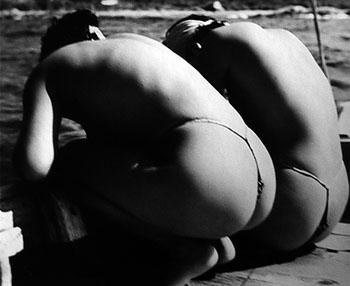
[Photo by Fosco Maraini.]
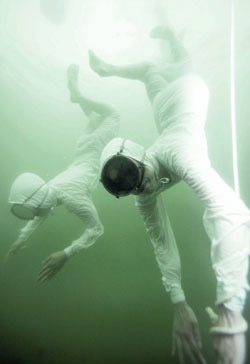
Ama traditionally are free divers, almost exclusively women, who dove for seaweed and shellfish (like sea snails, abalone, lobster, oysters). Occasionally the oysters they dove for contained pearls but this was not their goal. Interestingly, it wasn’t until Mikimoto was trying to promote his pearls did he hire ama to “dive” for pearls as a propaganda stunt. Actual be-loinclothed women were a bit too shocking for his upper-crust clientèle, and yet, the image of naked young women wrapped in semi-sheer white fabric free diving into the cold tumultuous ocean to capture the very pearl you wear upon your breast was a compelling one. Mikimoto was a total fucking genius.
[Japanese Ama as realized by Mikimoto. I have to say though, I’m liking the loincloth with the big-ass knife/pry-stick look better.]
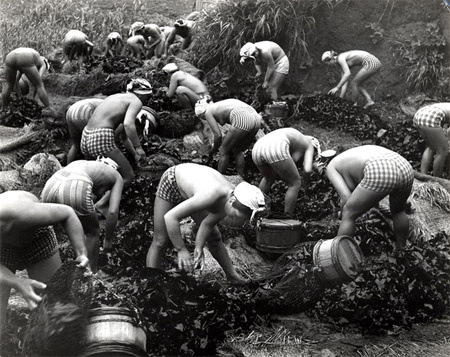
Up until the middle 50s-60s, they dove only in loincloths. Then they wore the head-to-knee white outfits you see popularized by Mikimoto. Nowadays real working ama are interested in wearing whatever makes them most visible to boats, which usually is bright orange. Other than that, ama still dive for shellfish and seaweed as they have for 2000 years, with no air and no wetsuits. Obviously, diving with full scuba gear would allow them to stay down all day but they choose not to go this route. Depleting the shellfish population so rapidly would be harmful not only to the environment, but to their own livelihoods. They have struck a rare balance that has endured throughout the centuries and into modernity.
[Harvesting Seaweed, 1956, by Iwase Yoshiyuki. For more amazing photos by this guy, go here.]
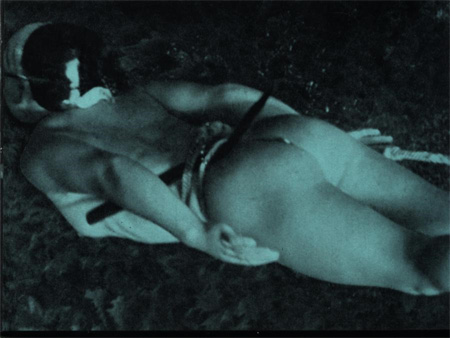
[Seriously, my ass is getting kicked just sitting here looking at this photo. Photo by Fosco Maraini.]
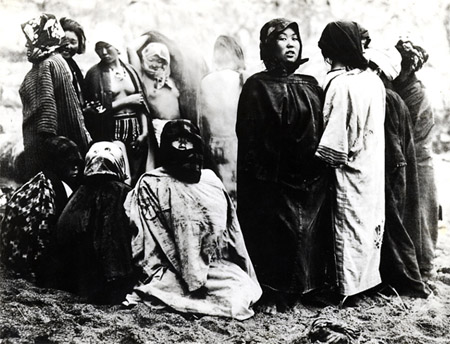
“Water temperatures on the Onjuku coast are bearable only between June and September. Large harvests were impossible to haul up in strong currents, so tides had to be favourable, limiting diving days to about 20 per year. Ama dive in three sessions a day, requiring extensive eating and warming at the fireside between runs. A good daily harvest required 60 to 80 dives of up to two minutes each, so ama had to develop and maintain substantial body fat to guard against hypothermia. With such rigors and risks, ama were paid enormous salaries, often making more in the short season than the village men made the whole year. In the late 1920s there were around 200 ama active in Onjuku and the seven harbours of the region (Kohaduki, Ohaduki, Futamata, Konado, Tajiri, Koura and Nagahama). By the late 1960s, they had disappeared.”
I took the quote from here—an interesting read—but I can’t actually find the original author. Here’s a brief and very good article about ama.
[“Around the Fire,” 1931, by Iwase Yoshiyuki. Ama warm up between dives by a fire on the beach.]
I find it intriguing that free diving in cold water is something that most men simply cannot do; generally speaking, women’s bodies can handle cold water stress and mild hypothermia better than men’s. It was, and is, intense, dangerous, and backbreaking work, yet these women love to dive. They are real-life mermaids, every bit as mysterious and powerful and otherworldly as the mythical ones.
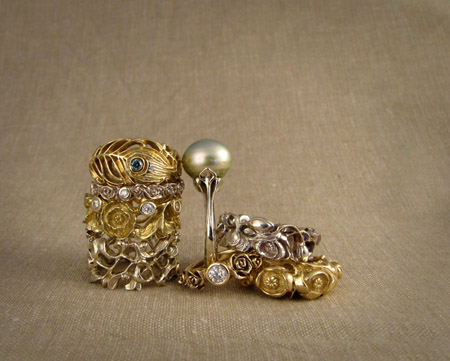
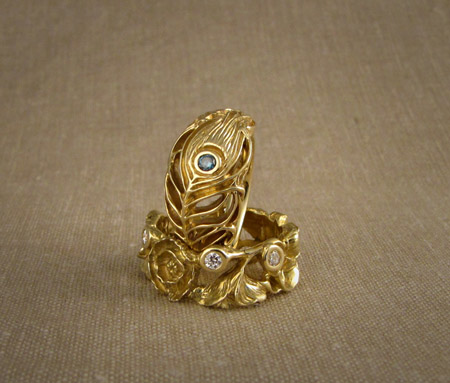
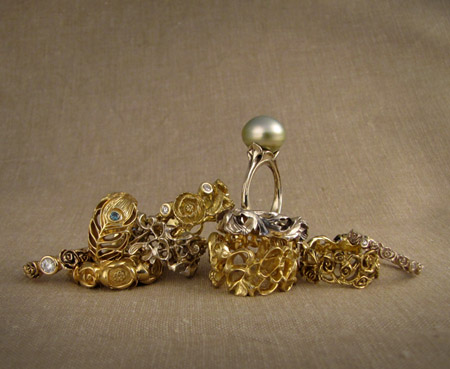


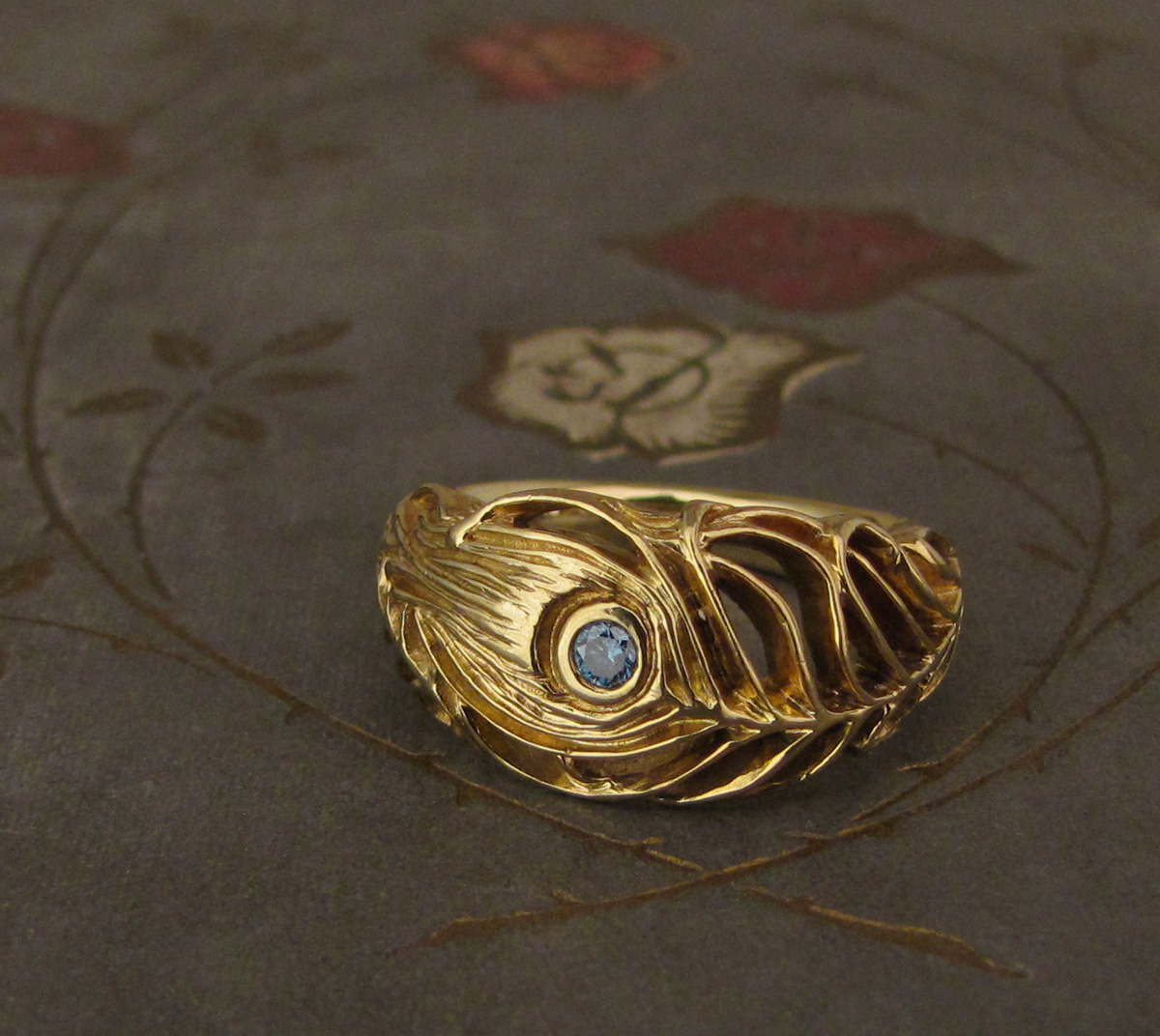 This probably looks familiar.. I carved a similar more petite version for Caty’s wedding ring. Carving her ring inspired me to dig out my old peacock ring wax (started years ago but never got very far) and give it another go. The design was a little different though in that I had the peacock’s body on one side, the feather (pretty much like it is now) on the other. It is a lot wider than Caty’s ring but narrow at the base for comfort; I also left the bottom of the ring bare and uncarved. I picked and scratched at it a little and finally decided to cut out the bird altogether, which was just looking a little too scrappy and messing with my clean lines. I recarved it wider on top and made it domed slightly (it’s hollowed out lightly underneath). I’m pretty pleased with the result.