ghezal’s ring

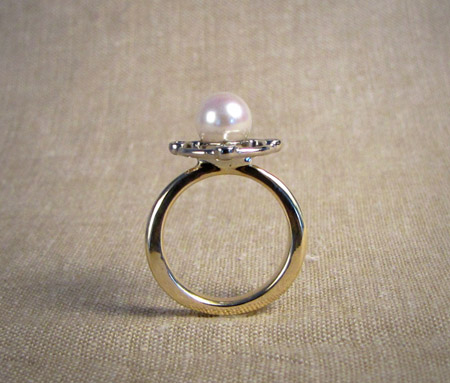
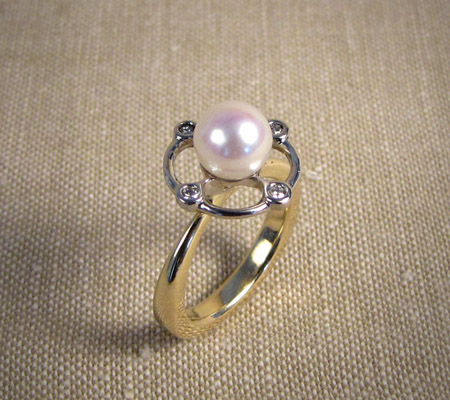
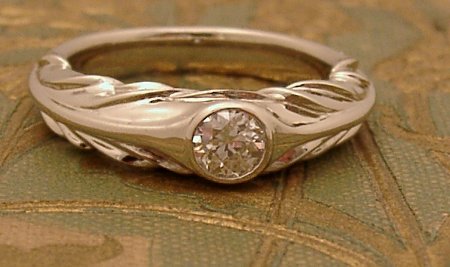
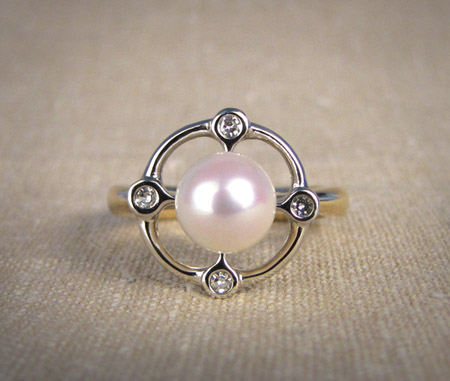
Two-tone 14K, diamond, Japanese Akoya pearl, art deco inspired ring

This ring came into being when Ghezal sent me a pair of stud earrings she never wore. The pearls were petite Japanese akoyas, and too small for the pearl ring designs I had (I typically use Tahitian and South Sea pearls, which are from a much larger oyster).

I dinked around with some ideas and even carved something that seemed good in my mind, but actualized in purple wax, it was kind of ugly. Then Ghezal said she wanted diamonds too and sent me an old diamond cluster cocktail ring to disassemble. Nothing like a passel of diamonds to sparkle up one’s imagination, and I reworked the design into more of an art deco inspired piece. She also casually mentioned she wanted it two-tone: white gold where the diamonds are and yellow gold for the band part, which at first freaked me out but it turned out to be not as hard as I thought it would be and of course, it’s pretty much awesome.

Two-tone 14K, diamond, Japanese Akoya pearl, art deco inspired ring

Two-tone 14K, diamond, Japanese Akoya pearl, art deco inspired ring

Two-tone 14K, diamond, Japanese Akoya pearl, art deco inspired ring

I love how this ring turned out.

ghezal’s pendant

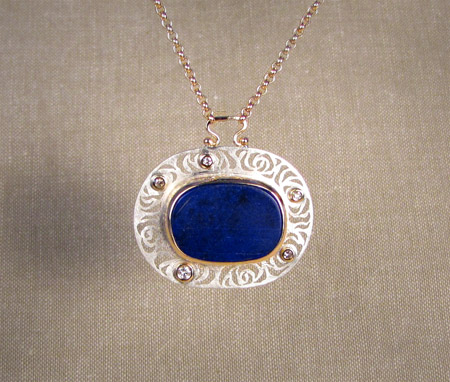
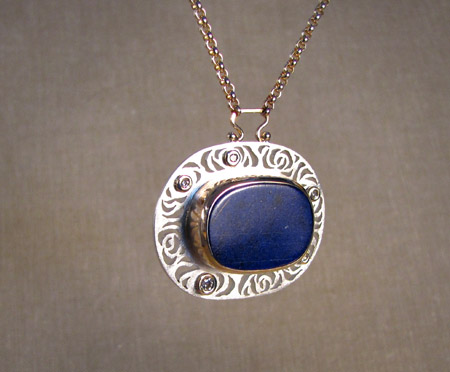
14K gold, sterling silver, diamond and lapis rose pendant

[14K gold, sterling silver, diamond, and lapis rose-motif pendant.]

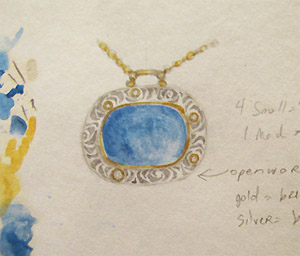
My sister in law’s family is from Afghanistan, a part of the world renowned for its intense blue lapis. Her father gave her some pieces that he had carried over from the old country (there’s more to the story than that, but maybe she can tell it sometime) and she had me make a few pieces. This is a pendant using a stunning tablet-shaped piece, about 17x23mm. The diamonds are recycled out of an old froofy pom-pom of a cocktail ring.

14K gold, sterling silver, diamond and lapis rose pendant

This piece was a challenge for me, not so much technically but mentally. I had never worked constructing gold before, nor had I done gold AND silver together. I have always been too nervous to construct using gold because of the waste; gold is just too expensive these days. But I got over myself and actually with this piece, I managed to be creative and had very little waste. Also it turns out that soldering gold is a dream come true, especially if you are accustomed to soldering silver.

Here was my design rendering.

"watercolor and pencil rendering: 14K, silver, diamond, lapis pendant

thank you everyone!

I’ve just finished up my last convo of the evening and I just wanted to plant a wet beery kiss upon everyone who took time out of their lives to not only look at my work, but send me messages telling me how much they liked it! I’m totally overcome, I tell ya. Anyway, thank you all so much. You all seriously made my last couple of days!

(If you don’t know what I’m talking about: dude. My moment of fame.)

etsy featured seller: ME!

This is so freaking exciting! My two days to shine are happening as we speak and I’m on Etsy’s front page with a featured seller photo (dork!), shop links, and interview and everything.

Of course, I spent hours and days obsessing over my interview questions and then suddenly the deadline was upon me and I freaked, quickly made sure I didn’t have any grotesque spelling errors, and just sent it in. Now I’m all, ohmygod: I forgot to say this, I should have said that, and I totally sound like a spazz!

Anyway, I’m very excited and also a bit nervous. Will anyone even read it? Will people actually go look at the things I make because of this? I have no idea what to expect.

ps – I would have put a pretty picture at the top if my computer hard drive didn’t die. And Joshua’s computer’s power supply not give out. Or my studio computer’s monitor go bad. All in this past week. I’m running linux now off a bootable disk. Anyway, you’ll have to be content with some krazee kapital letters and excitable punctuation in the header.

mimi’s ring

18 white gold and diamond hand-carved ring

[18K white gold and diamond ring.]

My grandmother “Mimi” died a number of years ago and though we never lived geographically close, we were close in the way that grandmothers and their granddaughters are. I idolized her and thought everything about her was mysterious and magical.

Mostly I have all those homey odd memories about her that I collected over my childhood. She had curly white hair and wore enormous bifocals. Her house always looked exactly the same, year after year. Her bathroom was all porcelain and tile and felt wonderful on your feet as you walked in off the carpeting. She was a master knitter and all her knit things (we always got something hand-knit for Christmas) smelled a certain way—Woolite, my mother told me it was, which she hand-washed all her knits in. Her cooking was heavy on the baked goods (as a grandmother’s should be); she made these wonderful cookies every Christmas (Mexican wedding cookies) that were always just OUT on a table for anyone to snack on throughout the holiday but they contained nuts and as desperate as I was to eat them all, I actually disliked walnuts so much that I only ever managed to get through one or two. She lived in Tucson, AZ, and drove a car that had over the years all but disintegrated from the UV exposure. She loved the song by Stevie Wonder that went, “I just called, to say, I love you. I just called, to say how much I care…” and when I was in sixth grade it played on the radio all the time. We’d turn it up in the car and she’d sing along in her warbly voice.

It’s funny how when you are a child, you have no concept of other people ever having been young. Or that they once had a different life other than the role you know them in, namely, “grandmother.” I always thought it odd that my mother was so testy around her.

I only know snippets of her life now. She was born in a town in the midwest and spoke only German; she didn’t learn English until she was sent to school. She worked as a nanny when she was very young. She married an abusive alcoholic (my grandfather, a man I never knew, but who was a very well-respected lawyer) who was much older than she was. She never had a job after marrying until after he died, when she suddenly had, like, four—and she did a lot of volunteer work. And her hair was actually not naturally curly; she had it permed.

After she died, my mother (the only daughter) was given her wedding ring. It was old and worn and bent so she sent it to me to make something with, using the diamond.

Berdina Beerman-Bowden

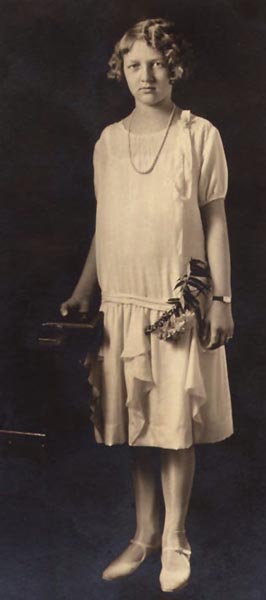
This was a photo of her from her first communion, I think it was. Anyway, I had never seen a photo of her in her youth. Old photos are always so interesting—the people with their rigid expressions and fantastic outfits. When they are of your own grandmother in her early teens, well, I was pretty fascinated.

The whole feeling of that old photo of her inspired my design for this ring, from the ruffles of her dress and the off-tint color, to the art deco era. My mother now wears Mimi’s ring.

Berdina Beerman-Bowden

Now I understand it was only a small piece of her that I knew. A fragment. I don’t find it sad or think it’s a bad thing though; her life was her own and I’m grateful to have participated in the parts that I did.

necklaces

Mostly I do rings. But, I have a soft spot for necklaces. And pearls. Pearls and necks make a great combination.
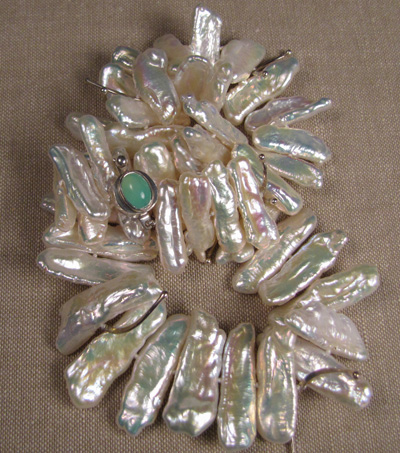
Chinese freshwater stick pearl necklace (peruvian opal clasp)

This is a strand of Chinese freshwater stick pearls knotted on silk; it has a hand-made box-style clasp with a Peruvian opal set into it. Stick pearls are just about the awesomest thing ever. They are so intensely iridescent because they are made entirely of nacre (The Shiny). They are created by inserting a bit of mantle tissue into a freshwater mussel. The mussel begins to coat the irritating invader with nacre in an attempt to neutralize it. The mantle tissue breaks down entirely but the mollusk continues to layer and layer bright shiny nacre over what is now a long skinny pearl. They make the coolest sound when they clink together, a bright watery sound.
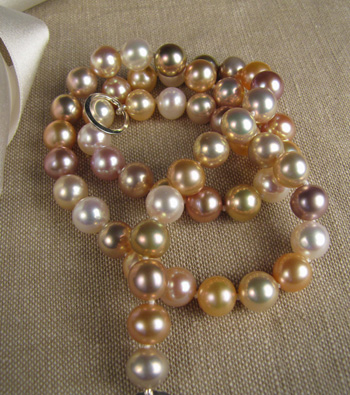
Chinese freshwater pink pearl necklace (knotted on silk)

I love Chinese freshwater pearls. Not only are the mussels prolific (and thereby delightfully affordable–you can nucleate a single freshwater mussel with upwards of 30 bits of mantle tissue, thereby creating 30 pearls), but they have a wide range of amazing colors and shapes. Ivory white to pinks are particularly beautiful. The strand above is a range of pinks, from bright orangy coral to dusty rose, and all natural color.
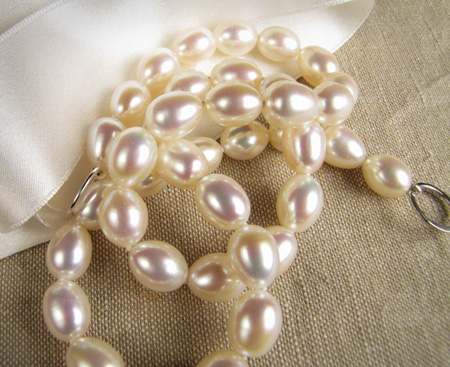
Chinese freshwater "potato" pearl necklace (knotted on silk)

More Chinese freshwater pearls, this time “potato” pearls, so-called because of their oval shape.
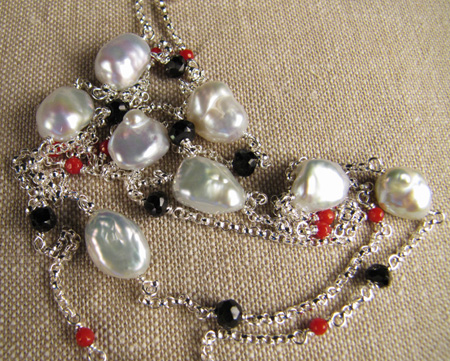
Black spinel, coral, and freshwater chinese keshi pearl necklace

This is a double strand (meant to loop twice about the neck at choker length, or be worn long) with Chinese freshwater keshi, faceted black spinel (a naturally occurring color), and tiny faceted pieces of coral. I find the black, red, and white colors striking and intense.

Keshi is interesting in that it is a pearl formed without nucleation. It is about as close to a so-called “natural” pearl that there is nowadays. However, there is a big difference in that instead of Joe Diver happening upon an oyster in the wild, popping it open and LO! a beautiful pearl, they are created in cultivated oysters. Usually, once a freshwater mussel has had all its cultured pearls removed (created by the insertion of mantle tissue), it is popped back in the water. Because the spots in its mantle are still very irritated after having the pearls removed, it continues to produce nacre and in most instances, this nacre sticks together to begin yet another pearl–this time solid nacre. They are beautiful.

It probably goes without saying: Pearls are probably not for vegans or anyone politically vegetarian.
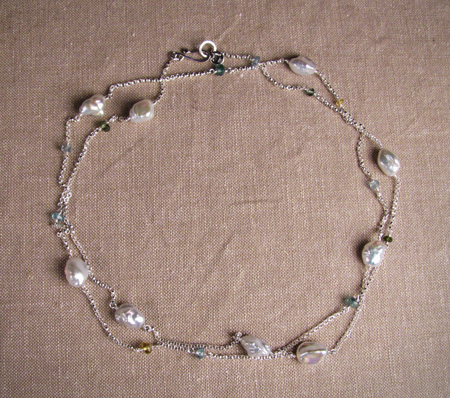
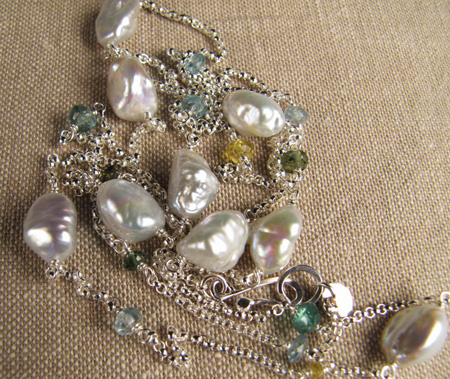
Tourmaline, aquamarine, and freshwater chinese keshi pearl necklace

This is the same style necklace as above but using faceted multi-colored tourmaline and aquamarines with the freshwater keshi. The icy blues and greens really set off the iridescent colors of the pearls.
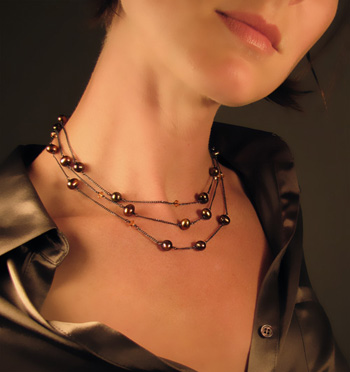
Chinese freshwater irradiated (bronze) pearl three-strand necklace

These are also Chinese freshwater pearls, but they are not a natural color. Originally, they were probably an undesirable brownish or grayish color, so they irradiated them. Now they are intensely black/bronze with serious iridescence. I think they are awesome. I strung them on sterling silver that has been patinaed a deep steely gray and sprinkled a couple of champagne-colored Austrian crystals here and there.

Chinese turquoise and silver long wrap necklace

Okay, we’re done with pearls for now. Here are a couple of super long strands made from sterling silver and gorgeous Chinese turquoises. This strand can be worn long, wrapped around the neck once or twice or three times, in a long Y-style, etc.
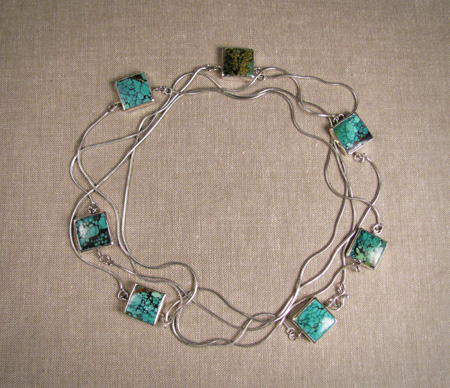
Square Chinese turquoise and silver long wrap necklace

Another super long strand, this time using square turquoise pieces. This can also be looped once or more times about the neck.

I’m working on getting the rest of my photos in order for all of the above pieces. I plan to list these (and a couple of others) in my Etsy shop in the next week or two.
caty and justin’s rings

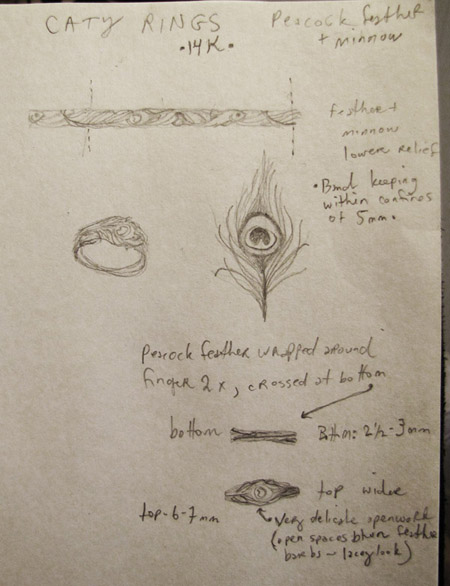
I got a recent commission for a matching pair of wedding bands with perhaps a fish theme (the owners had a sweet story about a minnow). I did a couple of sketches of minnows wrapped around a band. Then it came up that the peacock feather was the design theme of their wedding. Maybe we could work that into the ring…

A fish and a feather. Ooh!

[I may not know how to spell “lacy” but I do know my feather anatomy!]

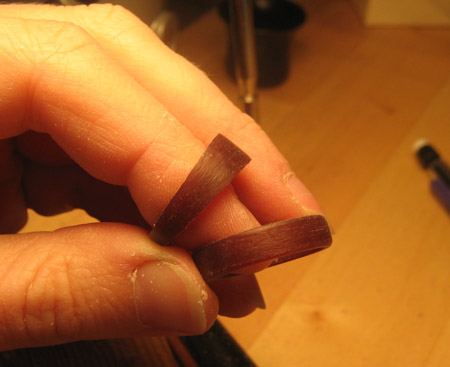
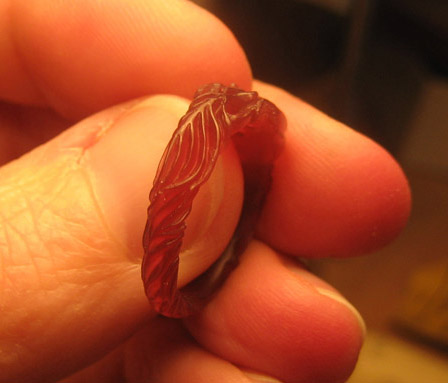
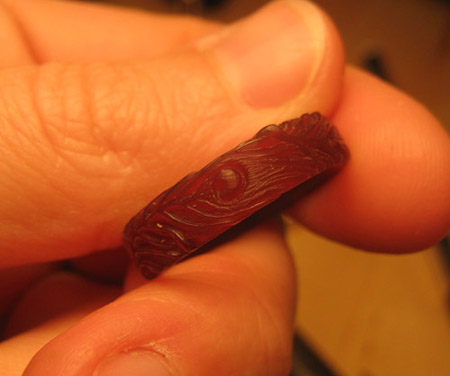
I really had a fun time carving these rings. A while back I sketched a design for a big ol’ peacock ring (peacocktail ring?) but never got around to actually carving it. Maybe I’ll dig it back out now because I love how the feather motif worked on the ring.

I start out evenly: cut waxes, cut out basic shape with file, scratch in design with something scratchy… Then I go to town. I try to keep continuity by carving on both rings, not getting ahead too far on one or the other, but inevitably at some point I lose myself and focus on one ring until I’m essentially finished.

As usual, I carved the first ring (hers) and looked at my rough scratches on the second ring (his) and said to myself: “Oh bother; how can I make this one as good as the first?” This happens every time. And every time the same thing happens.

I carve the second ring… and I like it even better than the first.

Then I feel bad for the first ring.

But after a short time my feelings equalize and I really find in the end that I don’t know which one turned out “best.”

Because they both turned out perfectly.

pheigi’s ring (wax carving process)

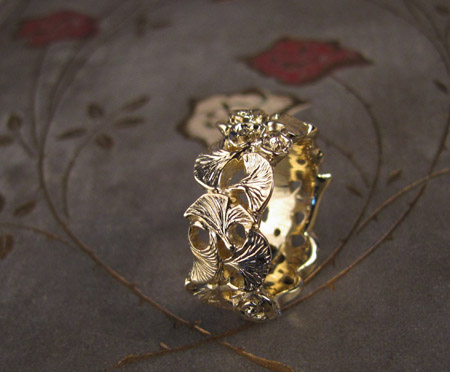
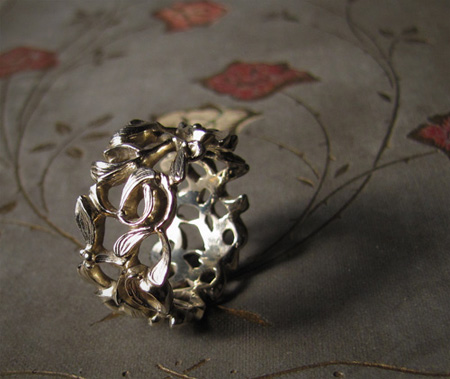
18K gold hand-carved rose and ginkgo leaf ring

18K gold custom rose and ginkgo ring. This is a recent custom order I finished for a woman in Japan.

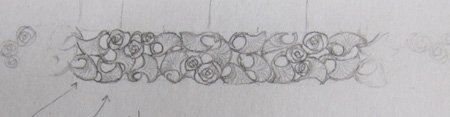
First I sketched a potential design. Once this was okayed, I could start in with the wax carving.

To start with, I hacked off a slice of carving wax the width of the proposed ring. I bored out the inside to the proper ring size, filed the sides parallel, and filed down the top to an even thickness. This step used to take me a ridiculously long time but now I’m pretty good at it and can brute out a general ring shape in no time. I typically carve a thick ring; rings feel better to me when there is some substance to them. I start with 2.5mm thickness generally and whittle down from there. The final ring will usually be around 2.25 thickness.

I measured out my three rose groupings so they would be even and balanced. Then I started to sketch out my design by scratching it onto the wax with a dental tool. I often have to adjust my design once actually laid out onto the wax since it always fits differently than it does on a piece of notebook paper.

Here I’ve bored out the holes between the ginkgo leaves and cut away excess wax. I use a regular twist drill and exacto knife to do this.

Neatening the openwork and starting to shape a little. Once I get the shape right, I start carving contour with a dental tool. I have a number of dental tools but I really only use one, which I’m absurdly dependent upon. I got it from my dentist years ago and sharpened a new, pointier point onto it. I broke one end of it off a few years back and I’ll be severely irritated if I ever break off the remaining end, which has thee perfect angled tip and the perfect amount of springiness and flexibility.

Here I’ve roughed out the shape on the leaves and started to form the roses. I’m going for a lot of movement on this ring, high relief.

The wax carving is almost complete. I go over and over the piece to neaten up edges, clean up my scratch marks, and make sure the continuity is nice between the outside carving to the smooth inside edge of the band. I often use 1200-grit sandpaper in this step, which is pretty much crazy time, but I always thank myself later when I don’t have to sand irritating scratches out of metal.

Once I’m finished with the basic carving, I do the finishing texture and details. Here I’ve done a bit more work on the rose petals and added the ginkgo leaf texture. The wax model is complete.

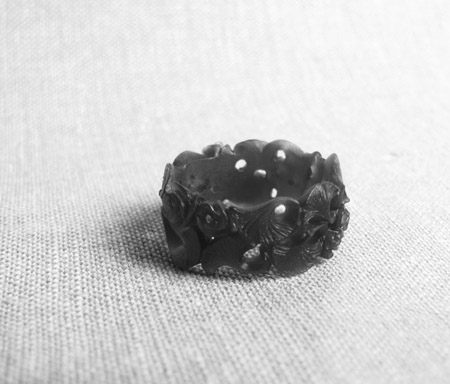
final wax for 18K ginkgo and rose ring

The glamour shots. Sometimes it’s hard to imagine the ring when it is purple wax… I’ve been experimenting with removing the color, etc. I can’t decide if it really helps though.

final wax for 18K ginkgo and rose ring

I’m still working on getting the lighting just right in the new studio. I took the finished gold photo before I got my diffuser working right. Unfortunately, it’s the only one that really worked and I didn’t get any others of different angles of the ring, showing more of the roses. Oh well.
18K gold hand-carved rose and ginkgo leaf ring

EDITED: You can see a photo spread of Pheigi & Kiichiro’s amazing Scottish/Japanese/Steampunk style wedding here.

art nouveau and mistletoe rings

It’s kind of ridiculous how long it took me to carve these rings.

18K white gold handcarved mistletoe ring

[18K white gold mistletoe ring.]

18K gold handcarved art nouveau ring

[18K gold art nouveau ring.]

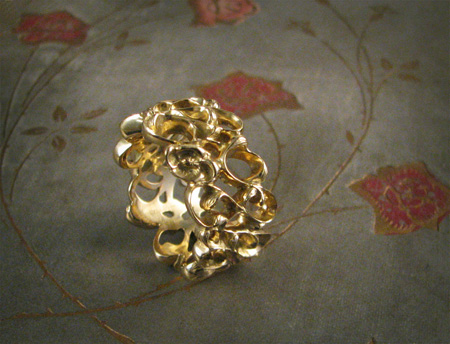
I based the art nouveau ring design on a photograph of an embroidery by Swiss designer Hermann Obrist (1890s). The image was in an art nouveau book I saw once and I just fell in love with it.

[Hermann Obrist, “Whiplash” embroidery of cyclamen.]

I finally got molds made of these two rings. Even so, there is still a lot that needs to be done to prepare the waxes for casting (not even counting sizing…) in that they are just very complicated designs. Both are really awesome though; a couple of my favorites.

Both the Mistletoe ring and the Art Nouveau ring have been listed in my etsy shop.

alisha’s ring

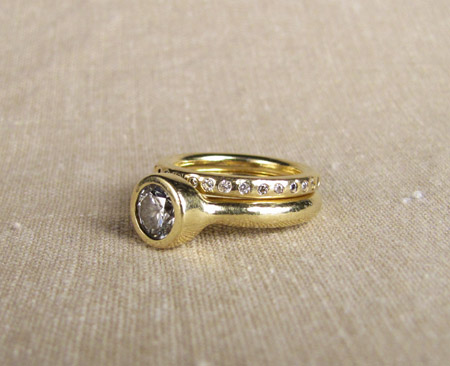
18K gold and diamond wedding set

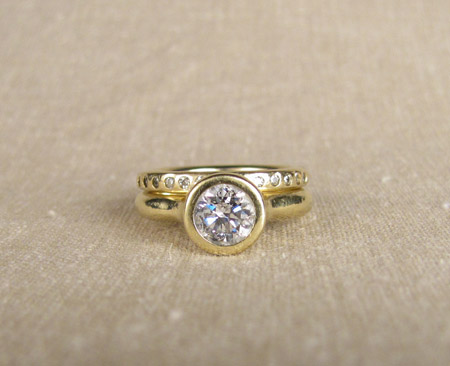
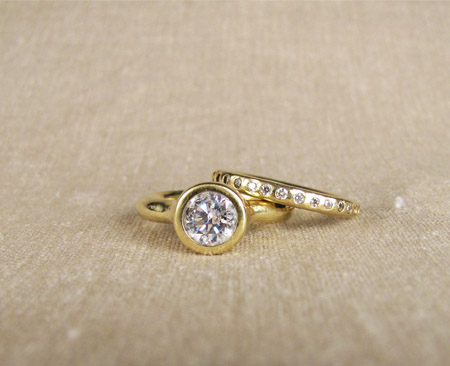
This is the wedding set I carved for my (old—sniff!) studiomate Alisha. It’s the most low-key ring I think I’ve ever carved (fat diamond notwithstanding…). She had a very specific idea in mind and wanted it to be something that could definitely take a beating. In fact, by the time I got around to actually photographing the ring, she had been wearing it nonstop, the past weekend while demo-ing a pidgeon coop and garage interior at her new house. I think the dings and scratches rather become it really. I wasn’t comfortable setting diamonds yet when I made it and so she took it to a professional setter. It turned out pretty damned awesome!

18K gold and diamond wedding set

18K gold and diamond wedding set

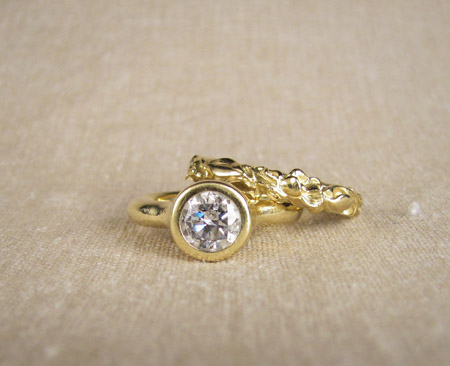
18K gold and diamond with carved rosebud band wedding set

Here I’ve paired her solitaire with one of my carved bands (the rosebud band). Sweetness!